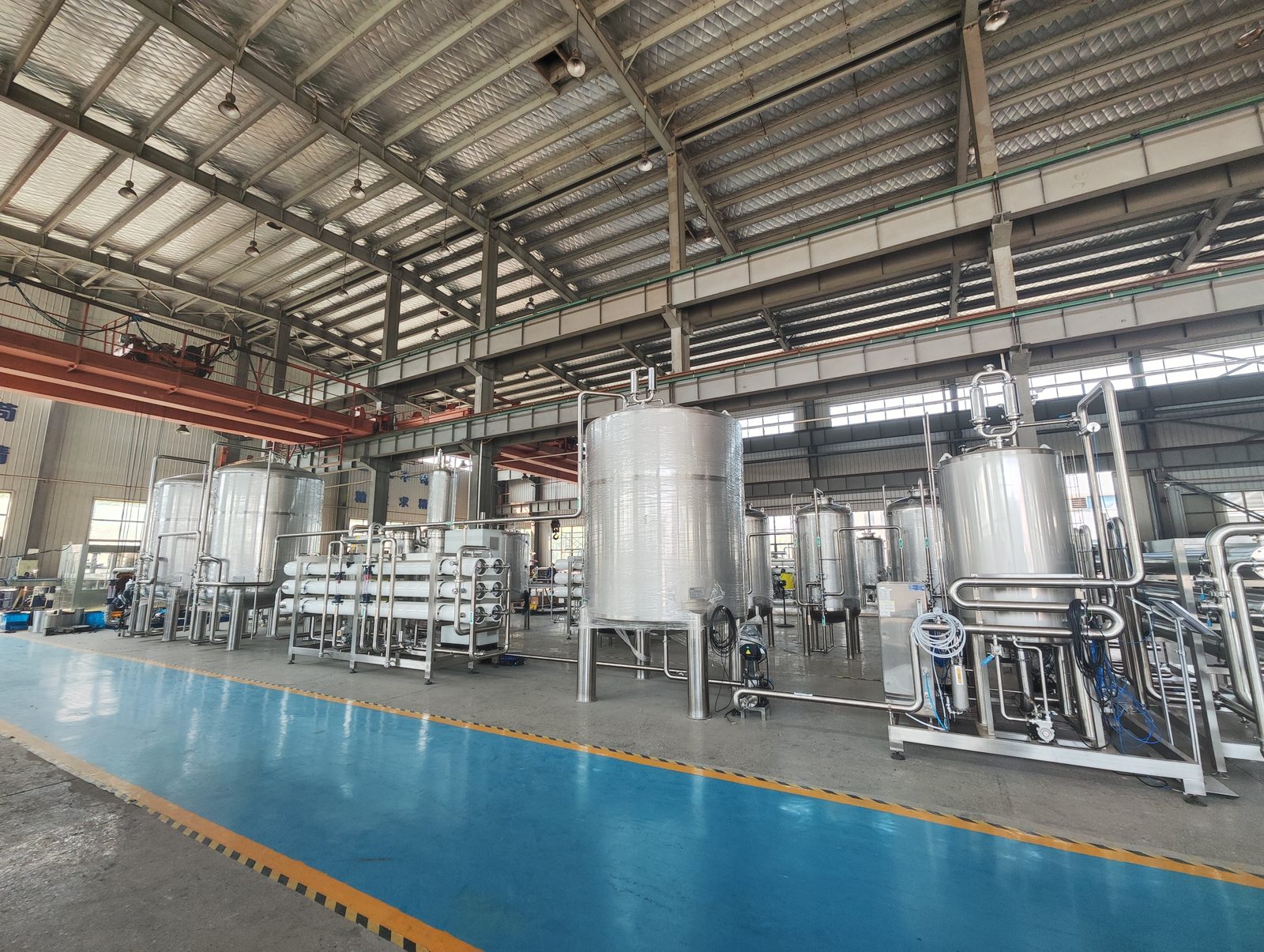
Water is the source of life and an essential resource in industrial production. Depending on the raw water quality and how the finished water is used, we need different water treatment. Linho mainly builds softened water, RO, ultrafiltration, brackish water, seawater and deionized water treatment systems.
Softened water treatment
Hard water contains a lot of calcium and magnesium ions. Equipment that uses it for a long time builds up scale — mainly calcium carbonate, magnesium carbonate and calcium sulfate — which reduces performance and service life.
A complete softening plant consists of a quartz sand filter, an activated carbon filter, a water softener and a precision filter. The sand and carbon filters (together the mechanical filters) remove suspended solids, odors and color.
The softener's active ingredient is ion exchange resin: tiny plastic beads carrying sodium ions. When water passes through, the beads swap their sodium ions for the calcium and magnesium ions in the water, so the hardness drops sharply. When the resin is saturated, it is regenerated with dilute brine (NaCl): the sodium ions in the brine replace the calcium and magnesium held in the resin.
RO (reverse osmosis) water treatment
RO uses pressure to push water through a membrane so fine that it removes almost all dissolved salts, colloids, bacteria and viruses. The purified water can be used to produce food and beverages or filled directly as pure water. Raw water can be any uncontaminated source: groundwater, spring water, river water, well water or municipal tap water.
A complete RO plant is a softening system plus the RO unit. The membrane is the core component. Over time its pores are blocked by impurities and it needs flushing; depending on the raw water, it is replaced every 2–5 years.
Ultrafiltration (UF) water treatment
Ultrafiltration uses hollow-fiber membranes and pressure to separate harmful substances while keeping the natural minerals — a very good choice for factories with a high-quality natural water source. A complete unit consists of mechanical filters and the UF membrane unit. It recovers close to 100% of the raw water, and the membrane is normally replaced every 1–2 years.
RO or ultrafiltration?
It depends mainly on your raw water quality.
| RO | Ultrafiltration | |
|---|---|---|
| Filtration accuracy | 0.0001 μm | 0.01–0.1 μm |
| Heavy metals | About 98% removed | Not removed |
| Minerals | Removed | Retained |
| Wastewater | Yes | None |
| High-pressure pump | Required | Not required |
| Noise and energy | Higher | Low |
| Best for | Almost all fresh water | High-quality water sources |
Both remove sediment and rust, residual chlorine and odors, organic compounds, colloids and bacteria. Only RO also removes viruses, scale and heavy metals. If your raw water is good, with no heavy metals or viruses, ultrafiltration keeps the natural minerals and saves cost.
Deionized water (EDI)
RO removes more than 99% of ions, but some trace elements, dissolved gases and weak electrolytes remain. Where those must go too — for example in electronics, batteries or solar cell production — electro-deionization (EDI) is used, normally after RO. EDI runs continuously without acid or alkali regeneration and produces no sewage, with an ultrapure water yield of up to 95%.
Brackish water and seawater treatment
Where fresh water is scarce — islands, ships, salt lakes or coastal areas — brackish water and seawater are purified with RO. Ordinary RO membranes handle water up to about 2,000 mg/L TDS, brackish-water membranes up to about 8,000 mg/L, and seawater membranes above 10,000 mg/L: seawater of 36,000 mg/L can be reduced to around 200 mg/L, better than tap water. These systems can also be built as modules — for example inside a container as mobile pure water equipment, or on board a ship.