Good equipment protects your water quality, saves maintenance effort and helps you reach your target market faster. Using the 5-gallon line as an example, here are the details worth checking when you select equipment.
Capacity
Standard 5-gallon lines are available from 100 to 3,000 barrels per hour — typically 100, 150, 300, 450, 600, 750, 900, 1,200, 1,500, 2,000, 2,400 and 3,000. The right size depends on your market and the degree of automation you want.
The production process
A typical line runs in this order:
- Cap remover
- Barrel washing (internal washing, internal brushing and external brushing)
- Washing, filling and capping
- Labeling
- Palletizing
If you also make your own barrels, a barrel-making machine sits in front of the line.
Making your own barrels
- PC barrels. A blow molding machine heats PC granules into a tube preform, then blows it into the barrel shape. Output is not high — usually below 100 barrels per hour. The system includes the blow molding machine, loader, mold, dryer, mold temperature machine, hopper, crusher, air compressor and air receiver.
- PET barrels. A bottle blowing machine heats a ready-made PET preform and blows it into shape. A semi-automatic machine makes about 90 barrels per hour; a fully automatic one makes 1,000–2,000. Fully automatic machines come in servo type and cylinder type — servo is more energy-efficient and efficient, but costs more. Molds can be iron (strong) or aluminum (light and easy to change).
For PLCs, HMIs and servo parts, Linho recommends internationally known brands.
Cap removing and pre-treatment
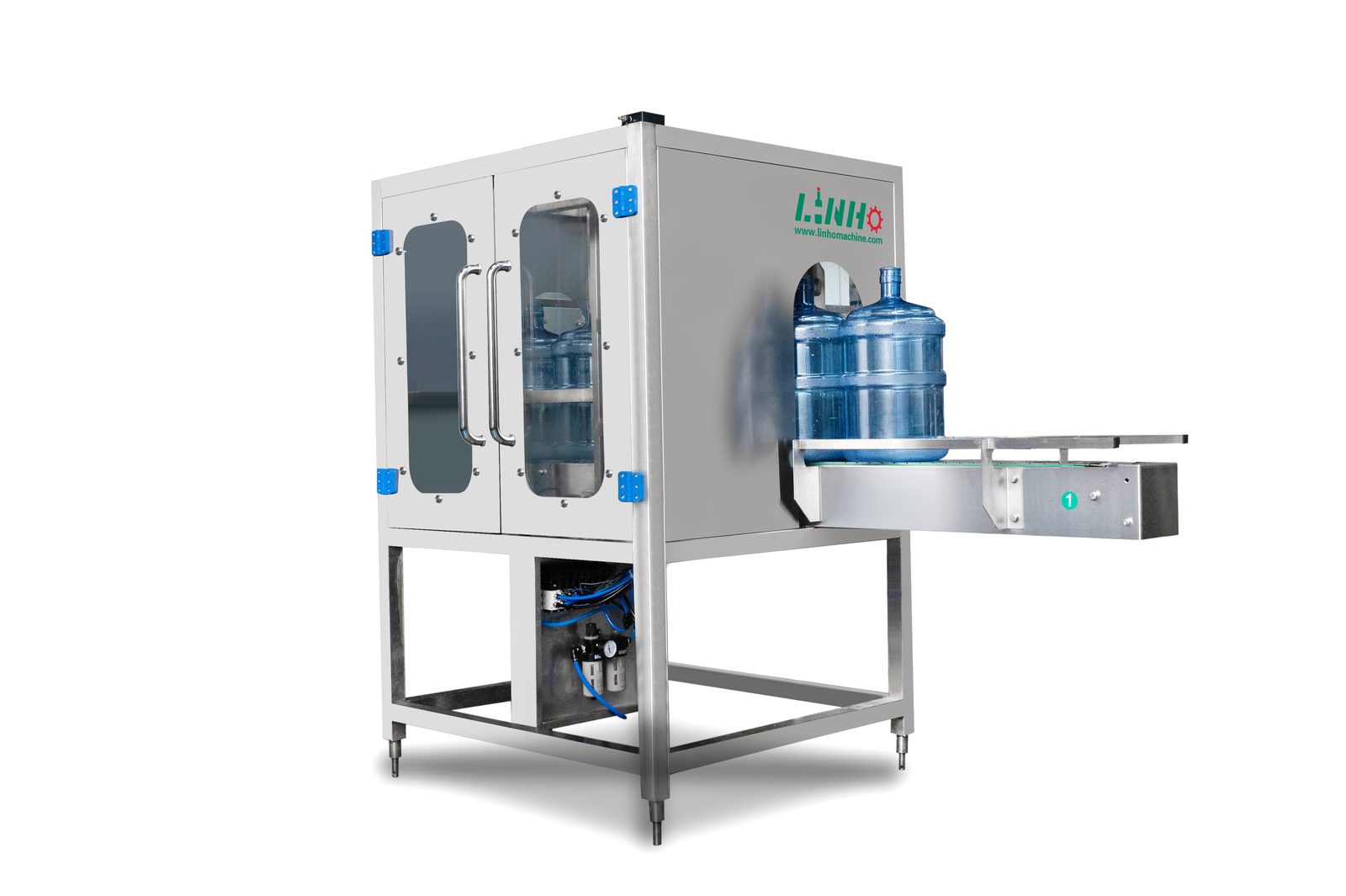
Below about 600 barrels per hour, one de-capper head is usually enough. Above 600 you need two heads or one high-speed head, and above 1,000 barrels per hour, two sets of high-speed de-capping machines.
Recycled barrels sometimes carry a label on the cap, so the cap remover can be fitted with a label-removal device and collection bins for the waste caps and labels.
For internal washing we recommend high-pressure washing, because brush washing can leave brush fragments behind. For external brushing, look at the number of brushes (single-row or double-row) and the build quality: good brushes clean the neck, body and bottom without scratching the barrel, and a rotary brusher with an anti-jam device runs fast without barrel jams. If your requirements are modest, a semi-automatic machine can be enough.
Washing, filling and capping
- Washing. Ask how many washing and disinfection stages there are, how many tanks and pumps, whether the tanks have a liquid-shortage sensor, and whether the rinse has a drip function. Without drip-drying, cleaning fluid can remain in the barrel.
- Filling. Valves must be food-grade stainless steel 304 or 316. For precision we recommend non-contact filling with a combination valve and frequency-controlled speed.
- Capping. An automatic cap elevator and cap unscrambler are recommended. For high hygiene requirements, add a cap disinfection and washing device.
Machine build and configuration
A sturdy frame (80 × 80 mm square tube) keeps a machine running stably for years. Linho uses 3–4 mm stainless steel 304 plates and all parts in contact with the product or water are SUS304. Electrical components use Siemens or Mitsubishi PLCs and HMIs, and can be customized to your requirements.
Labeling and palletizing
Cap labels can be applied by hand or by an automatic labeling machine. Barrel body labels can be applied by a single-side or a full-round labeling machine, and a special-shaped label labeler is available for high requirements. Palletizers come in different speeds: low-speed machines need the tray and suction cups placed manually, while medium- and high-speed machines place suction cups automatically.